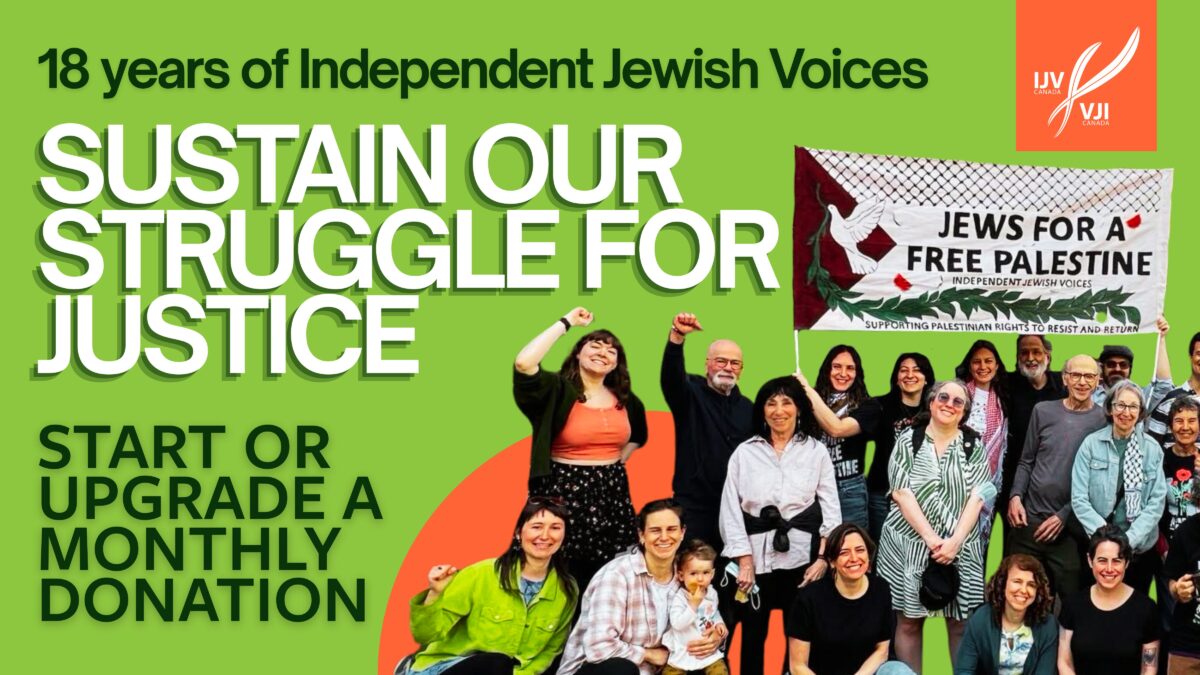
In August 2009, IJV steering committee members Diana Ralph (Ottawa), Sid Shniad ( Vancouver) and Howard Davidson ( Winnipeg) are attendedthe 40th General meeting of the United Church of Canada, regarding the UCC resolution on the Boycott, Divestment and Sanctions campaign (BDS). The Globe published two letters to the editor from Vancouver members of IJV – Sid Shniad and Carol Stone.
![]()
Aug. 10: Letters to the editor
Today’s topics: The United Church and Israel, Julia Child, green carrots,
From Monday’s Globe and Mail Last updated on Monday, Aug. 10, 2009 06:22PM EDT
The United Church and Israel
Bernie Farber, chief executive officer of the Canadian Jewish Congress, claims that anybody who votes in favour of four resolutions to be considered at the upcoming general meeting of the United Church of Canada is in favour of anti-Semitism (United Church Resolution Is Anti-Semitic, CJC says –Aug. 8). What are these resolutions attacked by Mr. Farber? In general terms they call for support of boycott, divestment and sanctions against Israel until it recognizes the right of the Palestinian people to self-determination.
Why these resolutions are anti-Semitic, Mr. Farber does not explain. They do not seek the destruction of Israel, but to change its behaviour. Israel must stop violating international law with the construction of illegal settlements in the West Bank and it must end its collective punishment of the 1.5 million Gazans through a blockade that denies them adequate food, medicine and building materials, and that prevents them from travelling abroad for study and commerce.
A similar campaign gradually led to the end of apartheid in South Africa, and South Africa and the world are better off for its success. If the campaign against Israel’s illegal behaviour is successful, Israel, the Palestinian people and the world will be better off as well.
Edwin E. Daniel, Victoria
…………
Once again the Canadian Jewish Congress is trying to silence critics of Israel by labelling such criticism “anti-Semitic.” Israel and Judaism are not synonymous. The United Church resolution concerns the state of Israel, not Jews.
Israel, as a nation state, must expect to take the consequences in the form of sanctions and boycotts for its deplorable treatment of Palestinians. What is “mind-boggling” is not the motion to be discussed at the United Church meeting, but the CJC’s repeated accusations of anti-Semitism toward anyone who dares to speak out about Israel.
Carol Stone, Vancouver
…………
Although Bernie Farber and the CJC purport to speak for Canadian Jews, this is not the case. Moreover, it is not anti-Semitic to debate issues and take action designed to bring an end to the long-standing crisis in Israel and Palestine.
At its recent annual general meeting in Ottawa, our organization – which represents a growing number of Jews across Canada – passed its own resolution endorsing boycott, divestment and sanctions as part of a growing international campaign to end the Israeli government’s intransigence. In contrast to Mr. Farber and the CJC, we believe that the United Church is to be commended for having the courage to confront this important issue.
Sid Shniad, co-chair, Independent Jewish Voices Canada, Surrey, B.C.
…………
According to Bernie Farber, if the United Church of Canada criticizes the state of Israel’s treatment of Palestinians, it is anti-Semitic. If this is true, anyone who questions the administrative practices of a first nations band council is anti-native. Anyone who condemns mass rapes occurring in the Democratic Republic of Congo is anti-black. And anyone who criticizes the United Church of Canada is anti-Christian.
Larry Hannant, Victoria
…………
The United Church’s response to the extremely complicated situation in the Middle East is simplistic: target only Israel and respond with boycotts and sanctions. There is never only one side to a conflict. If sanctions and boycotts are put in place, many innocent people will suffer. Does the United Church really think punishing Israeli academics abroad will move the government of Israel to fairer relations with the Palestinian people?
Celia Brauer, Vancouver
About Bil’in and this Tour
Bil’in, a Palestinian village located in the West Bank, has become an internationally celebrated symbol of Palestinian popular resistance to the ongoing construction of the Israeli apartheid wall and settlements. Since 2005, villagers have led weekly nonviolent protests, with active participation from both Israeli and international solidarity activists, in opposition to illegal Israeli colonization and annexation of Palestinian land. Almost 60% of Bil’in’s land has been annexed by Israel to date.
Bil’in has filed a lawsuit in the Quebec Superior Court against two Quebec registered companies: Green Park International and Green Mount International. The companies are accused of illegally constructing residential and non-residential buildings for the Israeli settlement of Mattityahu East on the Bil’in’s lands. According to the lawsuit, the lands of Bil’in are subject to the rules and obligations of international law because the West Bank is currently under Israeli military occupation. Bil’in’s case against the construction of settlements on their land is based on the provisions of the Geneva Convention, which prohibit an occupying power from transferring its civilian population into territory that it has occupied as a result of war. The case against Green Park and Green Mount seeks an immediate order from the Canadian court that it end its illegal activities.
In June 2009, Mohamed Khatib of Bil’in’s Popular Committee Against the Wall and Emily Schaeffer, an Israeli lawyer representing the village of Bil’in, will be embarking on a tour of 11 Canadian cities to speak on Bil’in and a historic court case scheduled to be heard in Montreal in late June 2009. They will be in Vancouver to talk about this case and Bil’in’s resilient struggle.
For more background information about the lawsuit, please see www.montrealmirror.com
For more information on Bil’in see www.bilin-village.org
In Vancouver, events are being organized by the Boycott Israeli Apartheid Campaign www.boycottisraeliapartheid.org
________________________________________________________________________
Endorsers and Sponsors
Locally these events have been endorsed and sponsored by: Adala – Arab Justice Committee, Canadian Arab Federation, Canada-Palestine Association, CanPalNet, Concerned Transit Operators of Metro Vancouver, Co-op Radio, Independent Jewish Voices Canada – BC, Jews for a Just Peace, Lawyers Against the War, Masjid Al-Salaam, No One Is Illegal – Vancouver, Outlook Magazine, Pakistan Action Network, Public Service Alliance of Canada – BC Region, SFPIRG, Social Justice Committee of the Unitarian Church of Vancouver, Solidarity for Palestinian Human Rights-UBC, StopWar, Vancouver District Labour Council, Vancouver Muslims, Vancouver Quaker Meeting, Vancouver Socialist Forum, UBC Colour Connected, World Peace Forum.
Nationally the Bil’in Tour is organized by: Solidarity for Palestinian Human Rights (SPHR), Tadamon, and Young Jews for Social Justice with endorsement and sponsorship from: the Canadian Arab Federation, Canadian Friends Service Committee, Canadian Voice of Women for Peace, Canadian Union of Postal Workers, Christian Peacemaker Teams Canada, KAIROS, the Near East Cultural and Educational Foundation, Canadian Friends of Sabeel, Science for Peace, United Jewish People’s Order, Womens International League for Peace and Freedom (WILPF) Canadian Section
Articles on Bil’in
An interview with Mohammed Khatib of the Bil’in Popular Committee by Stefan Christoff
www.tadamon.ca
National Post: Palestinian village sues Canadian contractors
bilin-village.org
CBC report about legal proceedings in Quebec – Canada (October 7, 2008)
bilin-village.org
Photo Gallery of Bil’in village non-violent resistance:
www.bilin-village.org
A letter from Mohammad Khatib honouring slain Palestinian Bassam Ibrahim Abou Rahme
his name was bassem
Photos: Solidarity with Bil’in in Montreal
www.tadamon.ca
Palestine: Bil’in international conference closing statement
www.tadamon.ca
While waiting for more content from the busy Vancouver members, we present :
- An open letter to the BC NDP for slamming their own candidate for criticizing Zionists
- A fascinating interview/debate on Jewish political activism by Gilad Atzmon with IJV co-coordinator and Vancouver member Sid Shniad
- A wonderful presentation by Bonnie Sherr Klein tiled: “There’s An Elephant in Our Closet: The Personal and Collective Dangers of Suppressing Dialogue on Israel and Palestine”
____________________________________________________
The NDP and the Big Lie About Israel: An Open Letter to Carol James ( BC NDP leader)
From the blog “Mostly Water” mostlywater.org
Note: For background information, see Charlie Smith’s excellent blog comment from the Georgia Straight.
Dear Ms. James:
As Jewish British Columbians we were disappointed and angered by your treatment of newly-chosen Kensington candidate Mable Elmore regarding comments she made some years ago about the difficulty of dealing with Zionists in her union when trying to organize around peace issues. We want you to know that we are not at all offended by Mable’s remarks but rather by your response to them, which we think does a disservice both to Jews and the community as a whole.
Mainstream Zionism is a political ideology that supports the creation of an exclusively Jewish state in the land of Palestine. The creation of the state of Israel and its many actions in violently repressing the indigenous Palestinian people, denying their human rights and repeatedly violating international law is a direct consequence of this Zionist ideology.
It is completely fallacious to equate the term “Zionist” with the term “Jew”. There are many in the Jewish community, including ourselves, who are very critical of the policies of the Israeli state and have strong disagreement with the Zionist organizations and individuals in Canada and elsewhere who defend these policies. With the recent brutal assault on the people of Gaza by the Israeli military, and the recent election of an Israeli government which includes openly racist demagogues such as Avigdor Lieberman, more and more people within the Jewish community and within the broader community are becoming critical of Israeli policies and want to see a change in the situation which could actually lead to a just settlement and peace between the two peoples.
The real aim of the Zionist leadership in branding people like Mable who criticize Israeli policies as anti-Semites is to try to extinguish any debate, discussion and analysis of the real issues in the Middle East. It is the new McCarthyism in the current political context. This is the Big Lie – to repeat endlessly that criticism of Israel amounts to anti-Semitism.
Your response to Mable’s words in that interview have helped to spread the Big Lie further and to repress any real discussion and debate over the difficult human rights issues in the Middle East. For the party of social democracy in British Columbia to take such action is shameful. We hope that you will reconsider your words and actions in this matter and attempt to set the record straight.
Sincerely,
Sid Shniad
Marty Roth
Martha Roth
Judith Neamtan
Eva Sharell
Carl Rosenberg
Lawrence Boxall
Bob Rosen
Rick Marcuse
Stephen Aberle
Joanne Naiman
Neil Naiman
Maxine Kaufman-Lacusta
For Independent Jewish Voices BC (a provincial chapter of Independent Jewish Voices Canada)
______________________________________________
Fighting Within – Gilad Atzmon Interviews: Sid Shniad (IJV Canada)
By Gilad Atzmon • Dec 19th, 2008 at 20:50
Recently I have been corresponding with Sid Shniad (1), a founding member of Canadian Independent Jewish Voice (Canadian IJV) (2). Those who are familiar with my writing are well aware of the fact that I am highly critical of any form of Jewish political activism, for I consider it to be a racially orientated discourse.
Yet, as much as I am interested in elaboration on the issue, a true dialogue with Jewish political activists is pretty much impossible. Jewish political ethnic campaigners and political activists have much to lose. They are fully aware of the categorical contradiction between the aim for universal values and tribal activism. They have much incoherence and inconsistency to hide.
Sid, however, was different, though we do not agree on many things, we have managed to keep an open and fruitful dialogue. He was very helpful and addressed each issue in a very positive manner.
Gilad: Hello Sid, I will start with a very brief question. Assuming that you are a secular human being, what makes you into a Jew? And what does it mean to operate politically as a Jew?
Sid: I come from a long line of irreligious Jews. My great-grandfather was a rabbi in Poland, but since that time there has been very little religion in my family. My father was not bar mitzvahed, but he strongly identified as a Jew.
Part of his identity stemmed from his experience of anti-Semitism. As a young man, he was an excellent student at the City College of New York. He desperately wanted to be a doctor, but was kept from medical school by the existence of stringent quotas on the number of Jews who were admitted.
In addition to that, however, he (and my mother, who was also from an irreligious family) became Communists during the Great Depression. They saw this as a logical step to take in response to what they saw as a fundamentally unjust society. I always felt that they became Communists for the right reason — to work for universal social justice — and that they quit being Communists for the right reason, when they learned Khruschev’s denunciations of Stalin’s crimes.
For me, being raised during the McCarthy era in the United States, being Jewish and being active in the pursuit of social justice were one and the same thing.
Gilad: I am still in the dark regarding your Jewish political identity. I am now more familiar with your family background, with your father being persecuted for being a Jew and with your parents’ decision to become Communists. This is a very familiar story which I can easily empathise with, however, I would expect that the transformation into Communism and ‘universal social justice’, should have led your parents to drop their tribal affiliation. Am I on a wrong track here? I’ll rephrase the initial question:
what makes you into a Jew? And what does it mean for you to operate politically as a Jew?
Sid: There were many Jewish Communists who continued to see themselves as Jews, Gilad. I gather from your question that you see this as an inconsistency.
Gilad: You are actually correct. I may as well remind you that Lenin elaborated on the issue when he criticized the Bund in 1903. The inconsistency is obvious, as the gap between the tribal and the universal is unbridgeable.
Sid: You are not alone in this view. Both Jews and non-Jews tend to see religiosity as central to Jewishness.
Gilad: Not at all, I am fully aware of Jewishness being a coherent identity yet it is a racially orientated one. Hence, I do not grasp the pretence of claim for ‘Jewish progressive activism’ and ‘humanism’. The question to follow is how do you bridge the gap between the Tribal, secular, racially-orientated identity (i.e. Jewishness) and the universal (e.g. Communism and Humanism)?
Sid: As a young man I read Isaac Deutscher’s book, The Non-Jewish Jew, in which he argued that there is a longstanding tradition of Jewish heretics who belong to a particular Jewish tradition. In their ranks Deutscher included Spinoza, Heine, Marx, Rosa Luxemburg, Trotsky, and Freud. All of them clearly went beyond the limits of conventional religiosity. (My father was a big fan of Deutscher.)
Gilad: This is obviously correct, you can add to the list Otto Weininger, Simon Weil and Christ and yet, the fact that some Jews were great Humanists doesn’t resolve the issue. As you probably know, Spinoza, Marx, Rosa Luxemburg and Trotsky did not operate politically as Jews. They were Humanists who happen to be of Jewish descent. Yet you are different, you operate politically as a Jew. In other words, you leave me no other option but to ask you the same question again:
What makes you, Sid, into a Jew? And what does it mean for you, Sid, to operate politically as a Jew?
Sid: You point out that Jewish Humanists have not tended to operate politically as Jews but you are curious about my experience, because you say that I do operate politically as a Jew.
Gilad: Let’s us try and be accurate. I made a note that the Humanists that you mentioned did not operate politically as Jews. However, I am interested in your case because you operate politically as a Jew. I want to learn how you bridge the gap between the chosen and the ordinary.
Sid: For most of my adult life, I have been active in non-Jewish Palestinian solidarity organisations, antiwar work, and left politics and resisted becoming involved in organisations that were identified as Jewish. But I have come to the conclusion that Jews with good politics on the issue of Israel and Palestine have a uniquely important role to play in combating the influence of the reactionary Zionist organisations that tend to dominate the Jewish community and providing telling criticism of the Israeli government.
Gilad: Now I am very happy because for the first time you really start to address my question. You also admit that, “Zionist organizations dominate the Jewish community”.
Sid: This realisation has led me to become active in creating Independent Jewish Voices in Canada in the last two years, where we have found that the organised presence of Jews who militantly oppose Zionist organisations and the Israeli government provides breathing space and a degree of comfort for both Jews and non-Jews who are uncomfortable with what Israel and its allies are doing, but who have been reluctant to come out of the closet on these issues.
Gilad: I fully respect your answer and I appreciate the honesty. Moreover, I understand the need of Jews to stand up and say, ‘we are different’, ‘we do not accept the Zionist Hegemony within the Jewish world’.
However, I must share with you some of my concerns and would I like to learn from you how you address these issues.
Chaim Weizmann said once: ‘there are no American Jews or French Jews but rather Jews who live in America and Jews who live in France’. In other words, the early Zionist leader suggested that Jewishness is a primary political quality. Wouldn’t you agree that acting politically as a Jew affirms Weizmann’s suggestion? How can you counter Weizmann’s argument while being a member of a primarily Jewish political group?
Sid: I would not interpret Weizmann’s statement to mean that Jewishness is a primarily political quality. Rather, I interpret this to mean that Jewishness is not akin to nationality.
Gilad: You may be right to say it when referring to the pre 20th century Jewish reality, however, Zionism was very successful in transforming Jewishness into a national identity, and as you already admitted, a very successful one. As painful and devastating as it may be, Zionism is the dominant voice within the contemporary Jewish discourse.
Sid: Frankly, I am surprised that Weizmann made this statement, since mainstream Zionism took it upon itself to create a Jewish nation-state. But I don’t feel the need to rebut it.
Gilad: I respect your decision not to rebut it. However, I wonder why it takes you by surprise. In fact, to a certain extent, once operating politically as a Jew within the Canadian IJV, you yourself act as a Jew who lives in Canada rather than a Canadian who happens to be a Jew. I hope you can see it. Anyway, let’s move on.
More than once I came across people who told me, ‘Gilad you can say it because you are a Jew’. My reaction has been rather radical. I dropped any form of Jewish entitlement. Consequently, I categorically refuse to operate as a Jew. I insist that everyone should be able to say what he or she feels regardless of his or her ethnic origin. One should be able to criticise the Holocaust industry or the official Zionist Holocaust narrative despite one’s mother not being a ‘holocaust survivor’. Similarly, one must be entitled to criticise Jewish power despite one not being physically or mentally circumcised. I am obviously concerned with the fact that Jewish progressive political activism actually suppresses the discourse. It elevates the chosen and silences the ordinary. I would like to learn from you what you think about it.
Sid: I heartily agree with you. That is the reason that for my entire life, until the last couple of years, my social-political activism has taken place outside of organisations that are identified as Jewish.
Gilad: I am very happy to hear it coming from you, as you may know my bitterest enemies here in the UK are actually two to four self-proclaimed ‘progressive Jews’. As far as I am aware, they must be cross with me because I have managed to pull the rug from under their feet exposing the severe incoherence in any Jewish progressive political activism.
Sid: Yet, we better acknowledge the unfortunate fact that powerful Zionist forces have capitalised on their Jewishness and used it as a club to neutralise and punish both Jews and non-Jews who are offside the Zionist project or who criticise Israeli crimes.
Gilad: We do agree here as well, and yet the question is how to confront the Zionist beast. And the place to start is, maybe, to ask where exactly Zionism ends and Jewishness starts. I believe that since Zionism and Jewishness are both dynamic notions, Zionism and Jewishness create a versatile amalgam that shifts rapidly and moulds into very many things. For that matter, I believe that there is no real demarcation between Zionism and Jewishness. However, this is my take, but what is yours?
Sid: I have come to the conclusion that there is an important role — not an exclusivist one — for Jews to play in combating Zionist organisations and criticising the behavior of Israel. At the same time, however, I continue to be active in non-Jewish organizations dedicated to Palestinian solidarity and antiwar work.
Gilad: It is very interesting and genuine the way you express it and I understand pretty well where you come from. In fact I wish you luck.
In the past I published some harsh criticism of the ‘not in my name’ political argument. I argued that those who shout ‘not in my name’ actually throw the blame on everyone else. Considering Jewish Independent Voice being a miniature body, you actually affirm the strength of Zionism by a approving its total dominance within the Jewish community. I wonder how would you counter this argument?
Sid: First, I don’t understand how saying “not in my name” blames everyone else. The logic of that escapes me.
Gilad: It is actually pretty simple, once you stand up and shout “Not in my name” you imply that everyone else who failed to join your choir is implicated with guilt. For instance, the two million Brits who marched in London shouting ‘not in my name’ a week before violence broke out in Iraq, affirmed that the 60 million who stayed at home approved Blair’s criminal policy. They actually foolishly admitted that a crime was about to be committed in the name of the vast majority of the British people. This is actually a very foolish tactic because in fact the majority of British people didn’t support the war. Following a similar logic, once Moishe, Chaim, Yatzek and another dozen Jews shout ‘not in my name’ as Jews, they basically affirm the devastating fact that Zionist crimes are committed in the name of the totality of the Jewish people who fail to shout.
Sid, you may note here that I do not blame the Jewish people as people for two main reasons:
a. I do not know all Jewish people;
b. I know enough Jews who do not care at all about Israel and Zionism.
Yet, I am exposing some fundamental fault in the ‘not in my name’ call. The Jazz legend Charlie Haden has managed to come up with a very clever solution. He decided to call his anti war jazz project ‘Not in OUR name’. This obviously made a lot of sense within the discourse of the British and American anti war movement. The Majority of Brits and Americans indeed oppose the neocon wars. However, it makes no sense within the context of Jewish political activism because the fact that 55-500 Jews around the world shout not in ‘our’ names while other millions participate actively in the Zionist murderous scheme makes the progressive Jewish project looks pathetic. It affirms the Zionist call.
Sid: Somehow, I don’t think that ‘affirm’ is the right term here. Instead, I would say that the strength of Zionism within the Jewish community (and beyond) cannot be denied.
Gilad: I am very happy to hear that you admit it, because as it seems the so-called Jewish progressive ethnic campaigners and activists on this side of the pool refuse to admit it yet.
Sid: So an organisation that is predominantly Jewish (we have non-Jewish allies involved in IJV) has a distinct role to play in the struggle against Zionism.
Gilad: Again, I can see where you come from, yet I hope that you can see also that the ‘not in my name’ is not necessarily the right tactic. All those lists of several hundreds of Jewish names look a bit sad in comparison to the many millions of Jews who are affiliated with Zionist activism in one way or another.
In short, the fact that two hundred Jews protest against the institutional Zionist crime is not going to vindicate the Jewish tribal collective.
Sid: Can you elaborate?
Gilad: Golda Meir said in the 1970s that mixed marriage is the greatest threat to Jewish existence. She was actually expressing a genuine fear of true assimilation. I would follow her line of thought and argue that the biggest threat to Zionist institutional crime is a true political assimilation of Jewish Humanists.
Rather than having Jews operating as a fifth column and gatekeepers within the solidarity movement, what we really need are Jewish Humanists like yourself and others to join the struggle for Humanism as equals amongst equals.
Sid, I hope that you wouldn’t mind me asking just one more question before we conclude this interview.
Is there such a thing as Jewish secular values or Jewish secular ethics? Zionism insisted upon portraying an image of a Jewish secular value system. It failed, but is there any other Jewish secular alternative?
Sid: My entire acquaintance with Jewishness has been secular. Some religious and Zionist Jews insist, therefore, that I’m not Jewish.
I find this view to be both ridiculous and a testimony to the degree to which secular political and social engagement, which was dominant in Jewish society in the modern world as recently as forty years ago, has been supplanted as a defining characteristic of the community by a revival of religiosity and the ascent of tribalism.
I would like to think that my activism — in Jewish as well as non-Jewish organisations — is the embodiment of a great Jewish tradition that is worthy of emulation.
Gilad: Sid, sorry to raise the question again, what is this ‘Jewish tradition’? As far as I can see the greatest humanists of Jewish origin actually stood against the so-called ‘Jewish tradition’ whether it was Christ, Marx or Spinoza. So please enlighten me briefly, what exactly is the ‘Jewish secular value system’? Can I read about it in any textbook? I ask you because I really tried to look into it, I indeed found many Humanists who happened to be Jews but none of them were referring to their universal ethics as the outcome of any ‘Jewish tradition’ or at least not a secular one. (3)
Sid: As I mentioned before, Isaac Deutscher wrote a book about this, called The Non-Jewish Jew, in which he described people like Spinoza and Marx and situated them in a tradition of Jewish opposition to the dominant mindsets of the Jewish community. In addition, I think that it’s essential to appreciate the disproportionate numbers of Jews who were involved in labour, civil rights, Socialist and Communist movements from the late 19th century through the late 1960s.
Gilad: Again we come back to the same point: some Jews had been great Humanists. But surely you can see that both Marx and Spinoza fought the Jewish tradition rather than continued it. They were aiming at universalism rather than tribalism.
Sid: Given my personal background, I always saw this involvement as the essence of Jewishness. It has been a rude awakening for me to see what has happened over the past 40 years, a period when Jewish paranoia, self-centredness and tribalism has come to dominate the Jewish community, thanks largely to the influence of Israel and Zionism.
Gilad: You know Sid, I have a slight problem with your last comment. If Humanist ‘involvement’ is indeed the ‘essence of Jewishness’, how come Zionism rather than Humanism is the dominant voice within the contemporary Jewish discourse? Unlike you, I do not think that Jewishness has anything to do with humanism. In fact I regard Jewishness, or at least its modern embodiment. i.e. Zionism, as categorically and institutionally inhuman. Like you though, I agree that some Jews are Humanists and even great Humanists. My interpretation of this wonderful phenomenon is very simple. Their greatness is the outcome of their protest and reaction against their own tribal upbringing.
Sid: This is exactly where Jewish activism comes into practice. I would like to see the Jewish community shake off this influence and re-join the ranks of those who side with the oppressed everywhere. Hopefully the efforts of organizations like IJV will contribute to that happening.
Gilad: Sid, I wish you luck again, Inshallah you’ll get there soon. Thanks for your time and effort. It was an enlightening experience talking to you. Since it was me who launched this interview, I would like to welcome you to say the final word.
Sid: I think I’ve said it!
Cheers!
(1) Sid Shniad (Pronounced “Shnide”)
Sid is an American expatriate who lives in Vancouver, British Columbia. He is active in the labour, antiwar and social solidarity movements, including StopWar.ca, the Vancouver-based antiwar coalition, the Canada-Palestine Support Network (CanPalNet), and a new national organisation, Independent Jewish Voices (Canada).
He was raised in Los Angeles during the McCarthy era. During the late 1960s, Sid attended the University of California at Santa Cruz, where he studied politics and political philosophy. To stay out of the U.S. Army during the Vietnam War, he taught school in the inner city of Los Angeles for five years.
Sid has lived and worked in Vancouver since 1974, where he has been employed as the Research Director at the Vancouver-based Telecommunications Workers Union (TWU) since 1980.
Sid’s activist inspiration comes from members of his family, who were trade unionists, socialists and communists active in the labour, civil rights and social justice movements.
(2) Independent Jewish Voices (Canada) represents Canadian Jews from diverse backgrounds, occupations and affiliations who have in common a commitment to social justice and universal human rights. IJV promotes the expression of alternative Jewish voices, particularly in respect of the grave situation in the Middle East, which threatens the future of Israelis and Palestinians, as well as the stability of the whole region.
We believe that human rights are universal and indivisible and should be upheld without exception, including Israel and the Occupied Palestinian Territories. The Canadian IJV sustains that there is no justification for any form of racism, be it anti-Semitism, anti-Arab racism or Islamophobia, under any circumstance.
The IJV insists also that the battle against anti-Semitism is vitally important and that it is threatened by the reflexive practice of branding opposition to Israeli government policies as anti-Semitic. We are attempting to reclaim the Jewish tradition support for universal freedoms, human rights and social justice.
(3) Emmanuel Levinas who tried to preach Jewish ethics to the world insisting that the birth of ethics was in Jerusalem was actually referring to the Talmud rather than any Jewish secular school.
**************************************************
There’s An Elephant in Our Closet:
The Personal and Collective Dangers of Suppressing Dialogue on Israël and Palestine
by Bonnie Sherr Klein
The following address was given at the Annual Outlook Supper, Feb. 17, 2008. Bonnie Sherr Klein is a noted film-maker (Not a Love Story; SHAMELESS: The ART of Disability) and disability activist. She describes herself as “increasingly uncomfortable with the dissonance between her identity as a proud Jewish woman and the actions of the State of Israel and its mainstream Canadian Jewish supporters.”
Thank you to Sylvia, Carl and the other members of the Vancouver Outlook Collective— where I first encountered some of the ideas we’ll be discussing tonight—for this opportunity, and to my family, friends, and especially Ellen Frank- we wrote this together in an electronic version of chevrut, the Talmudic tradition of learning in pairs.
Outlook editor Carl Rosenberg asked about my title: “Do you mean an elephant in the room? Or a skeleton in the closet?” Well, my brain injury does cause me to scramble metaphors, but this one is intentional. I mean both the conscious effort not to notice the huge presence of the Israel situation in our
lives; and the allusion to the sexual politics of the Closet: the self-censorship, and yes, even shame, which prevents us from dealing with that Elephant, and leaves no room for anything else to come in or out.
The reference to the Elephant is self-explanatory. Israel has become the predominant symbol of Jewishness. The Star of David is the Israeli flag. Whether we like it or not, it is impossible to extricate Israel from both Judaism (the religion) andJewishness (just being Jewish). For Jews and non-Jews alike, they are inextricably linked. The situation in Israel and Palestine is of central importance to our individual and collective Jewish identities, to our ethical consciences, and to the geopolitical situation of our times. But we can’t talk about it. The feelings are too hot. We are internally conflicted and externally censored.
The elephant is in the closet. So tonight is scary for me. But it’s also liberating. It’s good to be
talking aloud about what’s been hidden for so long. And it’s very Jewish to be talking. As I let people know that I was going to “come out” tonight, they responded, often tearfully, with their own stories of silencing. Questioning Israel disloyal to those who perished in the Holocaust?
Do we, who live comfortably in Canada and not in the tense realities of Israel, have the right to criticize or even question? Are we threatening the very survival of the country we love, and of the Jewish people, a vulnerable minority who must present a unified voice, especially to potential anti-Semites? Or does the continuation of present politics threaten our survival even more?
Individuals and groups who have voiced criticism aloud have been vilified by the press, shunned by their friends, excommunicated from family gatherings. One of our community here tonight who dared to speak out long ago was told he should have been killed in the ovens himself. Synagogues have been torn apart. Rabbis have been cautioned. Even my own congregation, Or Shalom, known for its independence of thought on many issues, banned discussion about Israel and Israel-related events from our group list-serve because it was so divisive. (Granted, it’s a bad medium for such discussion.) So I have learned to separate my “spiritual” Judaism from my “political” Judaism, which is a false and disturbing dichotomy.
Many of us have even had to ban the discussion in our homes. We choose “shalom bayit” (peace inour home) over honest and healthy dialogue—as if the two are mutually exclusive. This is curiously un-Jewish behaviour, for a people who have thrived (and survived) on the discussion of ideas. The costs of this suppression are loss of our wholeness as individuals, and the loss of potentially creative alternatives in a situation which every thinking person acknowledges is destructive and unsustainable in the long run. We need our best thinking.
Do you recall the story of the elephant and the blind men? It’s an old fable which appears in many cultures. A group of blind men are asked to touch an elephant and describe what an elephant is like. The man who touches her leg says the elephant is like a pillar; the one who touches her ear sees a fan, the trunk describes a tree branch. The moral of the story is that reality is viewed differently depending on our perspective, where we are standing. What does this elephant story have to do with Israel and Palestine? I don’t want to go into the usual debate mode tonight—the “who–did-what–to-whom-first” duel that so much of what we call discussion about Israel seems to begin and end with. Let’s just acknowledge that the story of the Elephant tells us that there is more than one narrative. There is more than the Jewish narrative about the land We now call Israel and They call Palestine. In Our narrative, May 28 1948 is Yom Ha’atzmaut, Independence Day; in the Palestinian calendar, it is the Nakbah, meaning catastrophe or disaster.
I’m no expert on Middle Eastern history or politics. I’m somewhat ambivalent—though increasingly
less so. I have more questions than answers. I-we need a safe place to begin this conversation out loud, which is not welcome in most Jewish gatherings,though I suspect and hope there is a silent (or silenced) majority of Jews who are as concerned as I am. I chose this venue because you readers and writers of Outlook have much to teach me, and I suspect much to talk about with each other. I’d assumed there was less ambivalence among the folks who were raised in secular and socialist circles, though I’m told that even at Outlook it’s not so easy to talk.
I’m going to talk personally in the belief that my experiences will resonate with many of yours. I represent more the so-called “mainstream.” I was raised with the powder-blue JNF pushke in the kitchen, by parents with undying love and loyalty to the country they referred to as “our poor littleIsrael”—never without those adjectives. They bought Israel Bonds and I saved my nickels to plant JNF trees. We cried together at the movie Exodus. I went to Hebrew-speaking camps, where Israeli singing and dancing made a potent cocktail with adolescent sex. I attended an excellent Jewish day school. I took pride in the athletic Judaism of the Palmach and Haganah. No longer were we bookish victims.
I went to Barnard College in New York so I could also take advanced teacher training at the Jewish Theological Seminary up the street. There I was educated by scholars and Conservative rabbis who added rich layers of learning. These included not only history and halacha, but also the lessons of the prophet Isaiah, of Tikkun Olam, of, “Am I my brother’s keeper?” I learned the tradition of dissent, of god-wrestling.
And as this was the early 60’s, this Jewish teaching fed my growing social awareness. It made sense that Jews were in the forefront of the Civil Rights and later the anti-Vietnam War movements , and that a Rabbi like the esteemed Abraham Joshua Heschel would march alongside Martin Luther King. There was no hint in my education that anything was awry in Eretz Zavat Chalav u’davash (Land flowing with milk and honey.) So I was entirely unprepared for the dissonance I experienced on my first visit to Israel, right after the Yom Kippur War in 1973. I felt joy at being in a place where everyone looked like my cousin—and confusion at the dismissive treatment of the underclass Arabs. The disconnect grew as the evidence mounted in future trips in the 80’s and 90’s. The Intifadas dramatized the difference in the narratives. The Jewish narrative is about being pushed into the sea, the stone— throwing, the rockets, the suicide bombs. The Palestinian narrative is about the humiliations, expropriations, home demolitions, and much worse human rights abuses: collective punishment, imprisonment, physical brutality, torture, killing in far greater numbers—all part of the now 40-yearlong-Occupation.
And it wasn’t in fact new. There has emerged what’s called a “New History”’ of the founding of the state on the part of both Palestinians and some reputable Israeli historians. They document a conscious strategy to eradicate the Palestinian presence in “the land without a people for a people without a land.” It’s been a painful loss of innocence, hard for me and so many other Jews who cannot accept these harsh contradictions of who we believe we are as a people. We all want to believe that we and our people are good, moral and just. So much of our identity is tied up with the dream of Israel. It is too hard to give that up.
My personal discomfort grew, until maybe it was time to peek out of the closet. In 2002, one year after Nine-Eleven, Vancouver’s Combined Jewish Appeal invited David Frum to kick off its annual campaign. Frum had just written The Right Man, a book about the moral courage of George W. Bush, whom he described as the Jews’ best friend along with his fellow religious Christians. Frum was coming to
Vancouver to rally Jewish support for Bush’s upcoming war on Iraq. I felt obliged to attend. After Frum spoke, several men made comments which accepted his premise totally. Trembling, I scooted to the microphone to ask the last question. I condemned all terrorism. But I also wanted to affirm that there were many Jews who did not support the unilateral U.S. war on Iraq, or Israel’s storage of U.S. weapons for that war. At which point the audience erupted with loud booing.
Frum had the last word, responding that the only alternative to violence is surrender, showing what Iwould call a dangerous lack of imagination, refusing to look at alternative, non-violent paths. At the reception afterwards, several people privately thanked me for speaking for them. In the following days, there were abusive voicemails and Letters to the Editor of the Jewish Western Bulletin [now Jewish Independent – eds.], accusing me of being misguided or self-hating.
I learned the lesson that my opinion was unwelcome in what I thought was my own community of
Jews in Vancouver. And I was silenced for several years. Until now.
So what’s the big deal, getting booed? Not much. Nothing compared with getting tasered, gassed, or bombed for your beliefs. But it is just one example of what in this decade has become an unprecedent-ed pattern of suppression of opinions which diverge from the Jewish mainstream. Speakers and cultural events are cancelled, academics are denied tenure, the media are accused of bias. I’m sure you can all think of local examples. I’m told Jews for a Just Peace has not been able to rent meeting space at the JCC. This suppression pushes many Jews outside the Jewish community, and the community is weaker for their loss. We can’t get to the best thinking because there is no real discourse. But despite this suppression, it’s obvious even from tonight’s turnout that many people want to have this conversation. We want to learn more. Some of us are frankly scared to go to events sponsored by Palestinian solidarity or other groups which we feel are too leftist, anti-Israel, or perhaps even anti-Semitic—our greatest fear. We cringe when our people are accused of wrong-doing. But tonight’s deadline forced me to step outside my comfort zone.
In January I saw an announcement for a film called Occupation 101, sponsored by the Boycott Israeli Apartheid Campaign. I had a knee-jerk antipathy to boycott and to the trigger-word apartheid, but the title of the film sounded like the primer I needed, a basic education from the side which I had not heard. My husband Michael agreed to accompany me. I want to report that we were greatly relieved. The film carefully avoided demonizing Israelis or Jews; it simply laid out the historical narrative and present-day facts on the ground from a Palestinian perspective. Interestingly, the people interviewed were all Israeli Jews—respected authors, journalists, historians, military heroes, politicians, and activists (religious included) who are challenging the dominant Israeli and Jewish narrative, people who are both pro-Israel and pro-
Palestinian. Pro-both—pro-ALL. They voice and embody the highest Jewish values, they model where we would all like to be, beyond the polarities of Us and Them, jettisoning the unhelpful trigger words like apartheid and Holocaust.
I have learned that many moderate Muslims and Palestinians feel as marginalized and even terrorized by extremists or ideologues within their own communities as many moderate Jews and Israelis do. And many of our non-Jewish friends are afraid of appearing anti-Semitic.
“An enemy is someone whose story you haven’t heard.” This is the simple teaching of Gene Knudsen Hoffman, a Quaker peace activist. My Inbox is full of e-mails from across the country and around the world now, teaching me of the many individuals and groups who are creating non-violent alternatives.Small groups have been meeting in living-rooms in Israel and the Diaspora, quietly, patiently, and sometimes painfully, often for many years—like the Palestinian and Jewish Women’s group Ellen Frank and Elizabeth Shefrin have been part of here since 1991. There’s a new group in another major centre, a handful of Jews and Arabs who are highly-placed in their mainstream organizations though they are still clandestine among their peers “until they have built strong and honest relationships, understanding each other’s narratives, solidly grounded in a human rights context,before they expand the circle of partners.” But I do not know of any Jewish-Jewish dialoguegroups in Canada. That work may be harder and scarier.
Outlook readers are familiar with local art projects like Elizabeth Shefrin’s Peace Quilt, and groups like Peace it Together, founded by Reena Lazar and Adri Hamael, which brings together young Israelis, Palestinians, and Canadians to tell their stories on film. These are all important examples of another process, one in which we can take pride. Most important, there is a diverse and passionate peace movement in Israel and Palestine. I am moved and inspired that Jewish and Palestinian parents who have lost their children to war have come together to found
the Bereaved Parents Circle. And young soldiers as well as distinguishedmilitary heroes refuse to serve in the Occupied Territories;they call themselves Combatants for Peace. There are Women in Black, Rabbis for Human Rights, and countless others.
The point is that we haven’t staked our claim for the possibilities of non-violent solutions because they are buried in the back of the closet, covered by that big elephant. The stories aren’t told and aren’t broadcast. A new organization is forming in Canada, the Alliance of Concerned Jewish Canadians. It’s an umbrella group of those who believe Canadian Jews should take a greater role in promoting a just peace. They want to represent the diversity among us, and challenge those who claim to speak in our name without consulting us. I hope they succeed in being truly inclusive and not doctrinaire. It is important that our diversity be visible to the Jewish community and to the rest of the world; that is our most powerful protection against the anti-Semitism we fear.
We need to create spaces in which it will be safe to confront our own and each other’s deepest fears without fear of ridicule or blame, to tell our own stories as they evolve and mature. To know our concerns are valid, intelligent, not naïve, very Jewish.
In preparing for tonight, I have discovered many sources and inspirations, including some Holocaust survivors and their children. They give me permission to ask the hard questions. They interpret “Never Again” not by building literal and figurative walls, but by passionately protecting the human rights of all people.
That’s the answer to my earlier questions about whether we have the right to raise our voices, as Canadians, as Jews. It is not only our right but our responsibility. And why dialogue? Because it invites the possibilities of creative pathways, lets the creative ideas out of the closet. This is what will bring me home to my Judaism. I want to be part of my people. I want our children, and their children, to stand proudly as Jews. We’re all looking forward to an open and respectful discussion, which hopefully we can continue with the wider Jewish community.